The 1897 Airship Wave: The Largest Single-Year Spike in 173 Years of Records
An anomaly detector run blind across the entire master dataset flagged 1897 as the most extreme yearly outlier on record, with 1,145 events at 57x the rolling baseline.
When the anomaly pass was run across the 173-year window of the Phenomainon master file, the largest single-year spike was not 1947, not 1952, not 1973, and not the 2014 dashcam era. It was 1897. The detector logged 1,145 events that year against a baseline median of 20 events per year, a ratio of 57.25x. The wave predates radio broadcasting, powered flight, and the wire-service saturation that drives most modern reporting clusters. It is, by the numbers, the anomaly the rest of the dataset is measured against.
A wave compressed into six weeks
The 1897 cluster is not spread evenly across the year. It is a April event with shoulders in March and May. Of the 1,145 logged sightings, 990 (86.5%) fall in April alone. March carries 54, May 35, and February 21. The remaining seven months together account for fewer than 50 reports. Whatever drove the wave, whether a genuine aerial phenomenon, a press contagion, a hoax cascade, or some combination, it ignited and burned out within roughly six weeks.
The geographic footprint is similarly tight. 1,107 of the 1,145 events come from the United States, with the Midwest dominating. Illinois leads with 173 events, followed by Michigan (157), Texas (124), Iowa (102), Ohio (79), Nebraska (77), Kansas (64), Wisconsin (58), and Minnesota (55). The wave tracks the rail corridors and the press networks of the late-1890s Midwest with notable precision. Coastal states are largely absent from the top fifteen. The handful of non-US entries (20 from China, 8 European, a scatter elsewhere) are too sparse to support cross-continental claims and may reflect database coding rather than a true international wave.
What witnesses described
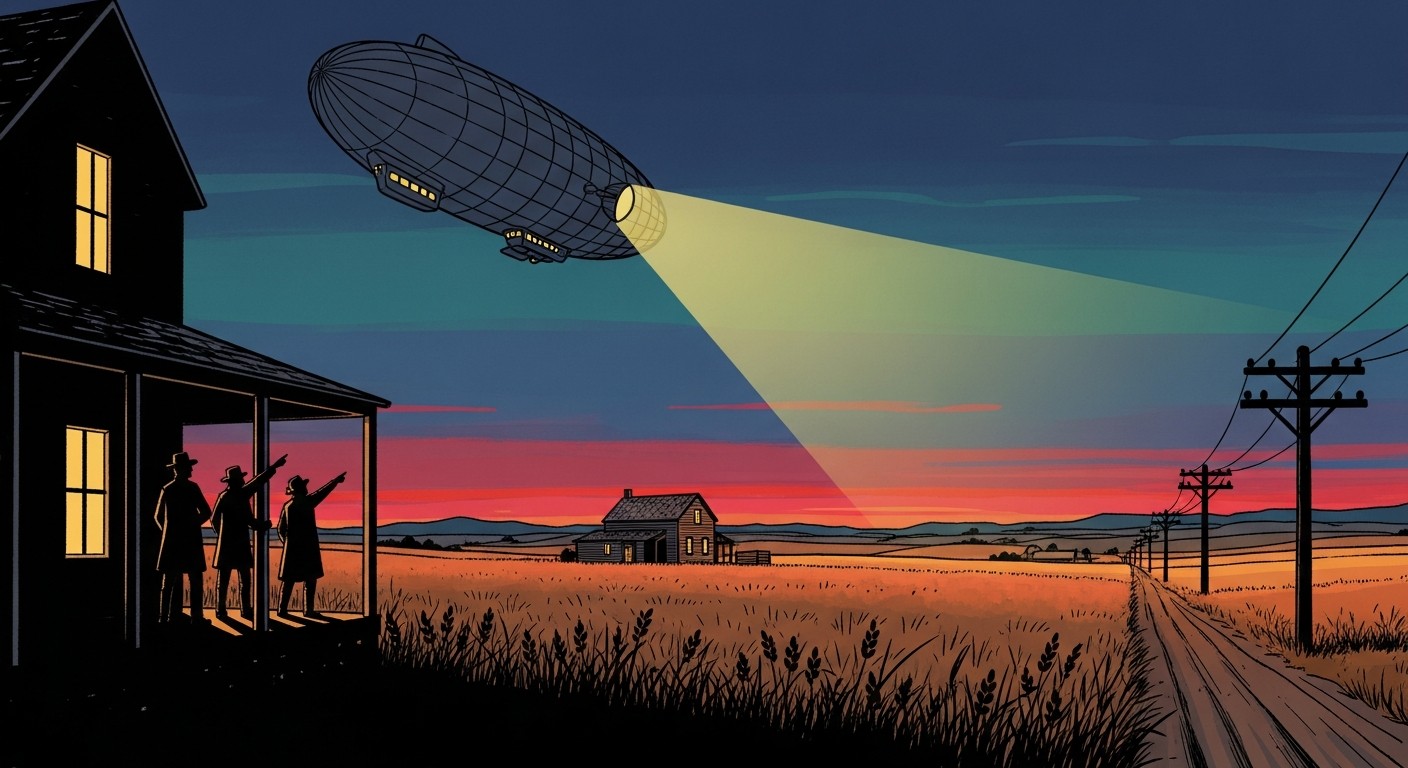
The descriptive content is unusually consistent for a pre-aviation era. Newspapers across the Midwest reported a cigar-shaped or "airship" object, often with a powerful searchlight, frequently maneuvering at low altitude and, in a striking subset of cases, landing and disgorging occupants who spoke with witnesses. The dataset's shape field is largely blank for 1897 because period reporters used the word "airship" as both shape and category, but where shape is coded explicitly, "Airship" is the dominant token.
The multi-source count is the part that resists easy dismissal. 301 of the 1,145 events (26.3%) carry two or more independent source citations in the file. That is a higher corroboration density than most modern years in the dataset, which is partly an artifact of historians having had 120+ years to compile newspaper indexes, but it is still notable. The most heavily sourced cases cluster in mid-to-late April.
PCF-002170 (1897-04-17, Williamston MI) carries nine cited sources. The narrative describes an object maneuvering for an hour before landing, with a reported occupant roughly three meters tall, and an injury claim against a farmer. PCF-002247 (1897-04-19, Le Roy KS) and PCF-002347 (1897-04-22, Josserand TX) each carry eight sources. The Josserand case describes a lighted object landing in a wheat field, with the occupants asking permission to draw water before a brief conversation with six men, an entirely mundane interaction wrapped around an extraordinary craft.
The landing and occupant subset
The 1897 wave is the earliest large-scale cluster in the dataset to feature what later researchers would call "close encounter" content. The Williamston case (PCF-002170) includes a described occupant and a claimed physical injury. PCF-002300 (1897-04-20, Uvalde TX), with six sources, names the pilot as a "Mr. Wilson" claiming to be from Goshen, New York, and references a prior meeting with another county sheriff. That detail, a self-identified human pilot of a self-identified terrestrial inventor's craft, is a recurring feature of the 1897 reporting that is largely absent from later waves. The 1897 witnesses generally did not interpret what they saw as otherworldly. They interpreted it as someone's secret invention.
Other heavily cited landing or close-approach reports include PCF-002171 (1897-04-17, Aurora TX), PCF-002217 (1897-04-17, Grand Rapids MI), PCF-001457 (1897-04-01, Kansas City MO), and PCF-002296 (1897-04-19, Sistersville WV). The April 17 date carries three of the top-sourced cases in three different states (MI, TX, MI again), which is consistent either with a genuine multi-state event or with a wire-service story that seeded simultaneous local accounts.
The press-contagion question
Any honest read of 1897 has to consider the role of newspapers. The 1890s American Midwest had dense competing local papers, no broadcast media, and a strong commercial incentive for sensational regional content. Once the Kansas City sighting on April 1 (PCF-001457) entered the wire pool, the story template was set: cigar shape, searchlight, low altitude, sometimes a landing. Early-April clusters in Chicago (PCF-001737, 1897-04-11) and Appleton WI (PCF-001758, 1897-04-11) follow that template closely. By mid-April the wave is in Texas (PCF-002257, Beaumont, 1897-04-19) and propagating south and west.
The data cannot distinguish between a real aerial event amplified by the press, a press-driven hoax cascade, and a mix of both. What the data can say is that the geographic distribution follows population and newspaper density, the temporal curve is consistent with a media contagion (sharp rise, peak, sharp fall), and the descriptive content converges on a single template fast enough to suggest copying. It can also say that 301 multi-source events is not a number that resolves to zero genuine observations under any reasonable model.
What this tells us, and what it doesn't
The 1897 spike is real as a reporting phenomenon. 1,145 events at 57x baseline, concentrated in 86.5% in a single month and 70%+ in nine Midwestern states, is the strongest single-year signal in the entire 173-year file. What the spike does not tell us is what people actually saw. The dataset cannot adjudicate between secret-inventor rumors, mass press contagion, hoaxes, misidentified astronomical objects (Venus was prominent that spring), and any residual genuine unknowns. It can only mark 1897 as the baseline against which every later wave, including 1947 and 1952, has to be measured, and note that the template of cigar-shaped craft with searchlights and occasional occupants entered the American reporting vocabulary 50 years before the term "flying saucer" was coined.
Methodology: how the corpus was built. Sources: the 8 catalogs feeding the master.