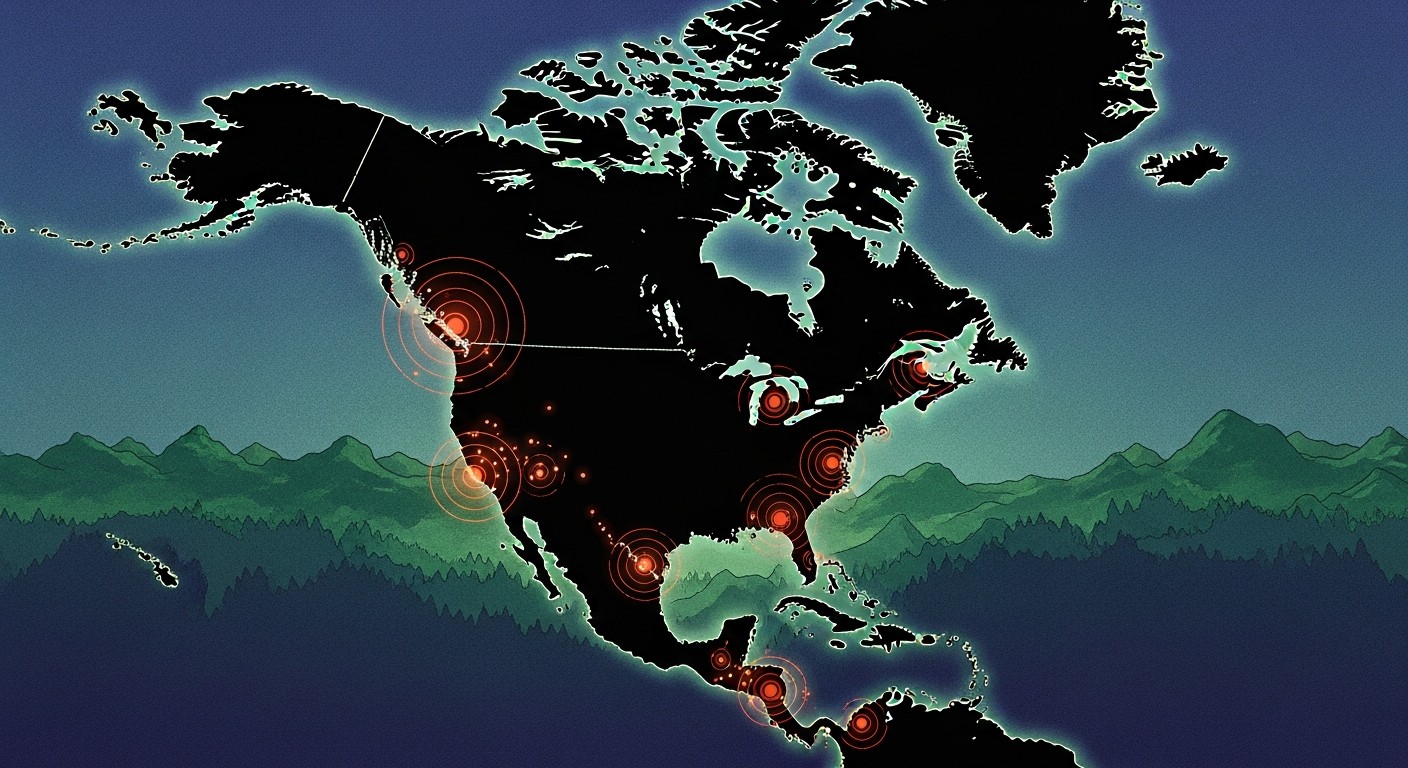
The Sightings Map Has Two Anchors: Wet Forests and Dry Deserts
Across 67,850 distinct city-state places in the Phenomainon corpus, the highest-volume American hotspots cluster into two regions that share almost nothing except open sky.
The Phenomainon master dataset contains 252,001 events spread across 67,850 distinct city/state place names. That dispersion matters: most places in the corpus carry only a handful of reports. But at the top of the distribution, a clear geographic pattern emerges. The 25 highest-volume US cities split between two regions with very different climates, populations, and skies: the Pacific Northwest and the desert Southwest. A third tier, dominated by Texas and the Great Lakes, fills out the list. Before reading any of this as a map of where "things happen," a caveat: coordinates exist for only 0.4% of events. What follows is a city-aggregation view based on the place name attached to each report, not a point-density map.
The two anchors: Seattle and Phoenix
Seattle, WA leads the corpus with 748 events and 42 multi-source cases, with PCF-142978 as a representative file. Phoenix, AZ sits a near-tie second at 734 events and 37 multi-source corroborations (PCF-173044). The gap between them is 14 events out of roughly 1,500 combined, which is well within reporting noise.
These two cities anchor the two regional clusters. The Pacific Northwest contribution continues with Portland, OR at 571 events and 41 multi-source files (PCF-172670), and extends north of the border into the Canadian dataset, where Vancouver, BC logs 333 events (PCF-002698), Victoria, BC adds 132 (PCF-139682), and Surrey, BC contributes 148 (PCF-149731). Taken together, the Cascadia corridor from Eugene to the Strait of Georgia is one of the densest report-generating regions in the entire corpus.
The desert Southwest anchor is broader. Beyond Phoenix, Las Vegas, NV produces 647 events (PCF-230265), Tucson, AZ produces 503 with an unusually high 59 multi-source files (PCF-230552), and Albuquerque, NM contributes 450 events and 41 multi-source corroborations (PCF-230364). Add Colorado Springs, CO (277 events, PCF-230576) and Denver, CO (443 events, PCF-230701) on the Rockies fringe, and the arid interior west becomes the single largest contiguous reporting region on the US list.
Why a city-aggregation view is the wrong tool for "density"
The number 748 for Seattle should not be read as "Seattle has the most UAP activity." It should be read as "Seattle has the most reports filed under the place name 'Seattle, WA'." Three confounds matter here.
First, population. Los Angeles, CA (691 events, PCF-222158), Chicago, IL (529 events, PCF-230289), and Houston, TX (427 events, PCF-230560) all show up in the top 11 in part because they have millions of potential reporters and well-developed local news ecosystems that channel sightings into databases.
Second, name attraction. Reports filed from suburbs and unincorporated areas often get tagged to the nearest large city. The Seattle and Phoenix counts almost certainly absorb reports from a wide metropolitan halo.
Third, name oddities. The list contains Gusher, UT with 415 events but only 1 multi-source file (PCF-125761), which is wildly inconsistent with the other top-25 entries. A town of a few hundred people producing 415 reports is almost certainly an artifact of geocoding, a default fallback, or a single source's tagging convention. It is on the list because the data say so. It should not be treated as a hotspot.
Multi-source ratios tell a different story than raw counts
If raw event count answers "where are reports filed from," the multi-source count answers "where are reports independently corroborated." Sorting the top 25 by multi-source files reshuffles the ranking.
Cincinnati, OH has 288 events but 66 multi-source files (PCF-230671), a 22.9% corroboration rate, the highest in the top 25. Tucson, AZ runs 11.7% (59 of 503). Los Angeles, CA runs 8.2% (57 of 691). Gulf Breeze, FL, with 328 events and 46 multi-source files (PCF-168944), comes in at 14.0%, reflecting the well-documented late-1980s wave that drew sustained investigative attention to one Florida town.
At the other end, San Diego, CA shows 487 events with only 16 multi-source files (3.3%, PCF-230420), Orlando, FL shows 372 with 8 (2.2%, PCF-230649), and the Gusher, UT entry sits at 0.2%. Low multi-source ratios in high-volume cities suggest either a flood of single-witness reports without follow-up, or an aggregation artifact rather than a real cluster of investigated incidents.
The practical takeaway: Cincinnati, Tucson, and Gulf Breeze look more like investigation-rich locations, while San Diego and Orlando look more like high-traffic submission channels.
The international list is shaped by which countries report into the corpus
The top international cities are heavily Canadian: Toronto (353, PCF-230896), Vancouver (333), Winnipeg (312, PCF-230544), Ottawa (250, PCF-137093), Edmonton (222, PCF-194352), Montreal (201, PCF-153494), and Calgary (195, PCF-230720). Seven of the top 15 international entries are Canadian cities. This almost certainly reflects which national reporting bodies feed the master dataset, not a genuine claim that Canadian skies are 7x more active than Australian or Brazilian ones.
Italy is the second-largest international presence, with Roma (308 events, PCF-236625), Firenze (153, PCF-236547), and Milano (152, PCF-236537). Australia contributes Adelaide (166, PCF-233765) and Sydney (133, PCF-143303). Brazil shows one striking outlier: Colares (165 events, PCF-089855), a small island town in Pará state whose presence on a global top-15 list is driven almost entirely by the 1977 to 1978 Operação Prato wave. It is the international equivalent of Gulf Breeze, a single sustained episode producing a city-level signal.
What this tells us, and what it doesn't
The data show two real regional concentrations in the United States, the Pacific Northwest corridor and the desert Southwest interior, plus a heavy Canadian skew internationally that reflects reporting infrastructure rather than sky activity. The data also show that raw event counts and corroboration counts disagree often enough that any "top hotspots" list should be read with the multi-source column open next to it. Cincinnati, OH and Tucson, AZ punch above their weight; San Diego, CA and Orlando, FL punch below. What the data cannot tell us, given that 99.6% of events lack coordinates and many counts likely include suburban halos and tagging defaults, is whether any of these cities have elevated sighting rates per capita per square mile. That question requires geocoded points and population denominators the corpus does not yet provide.
Methodology: how the corpus was built. Sources: the 8 catalogs feeding the master.