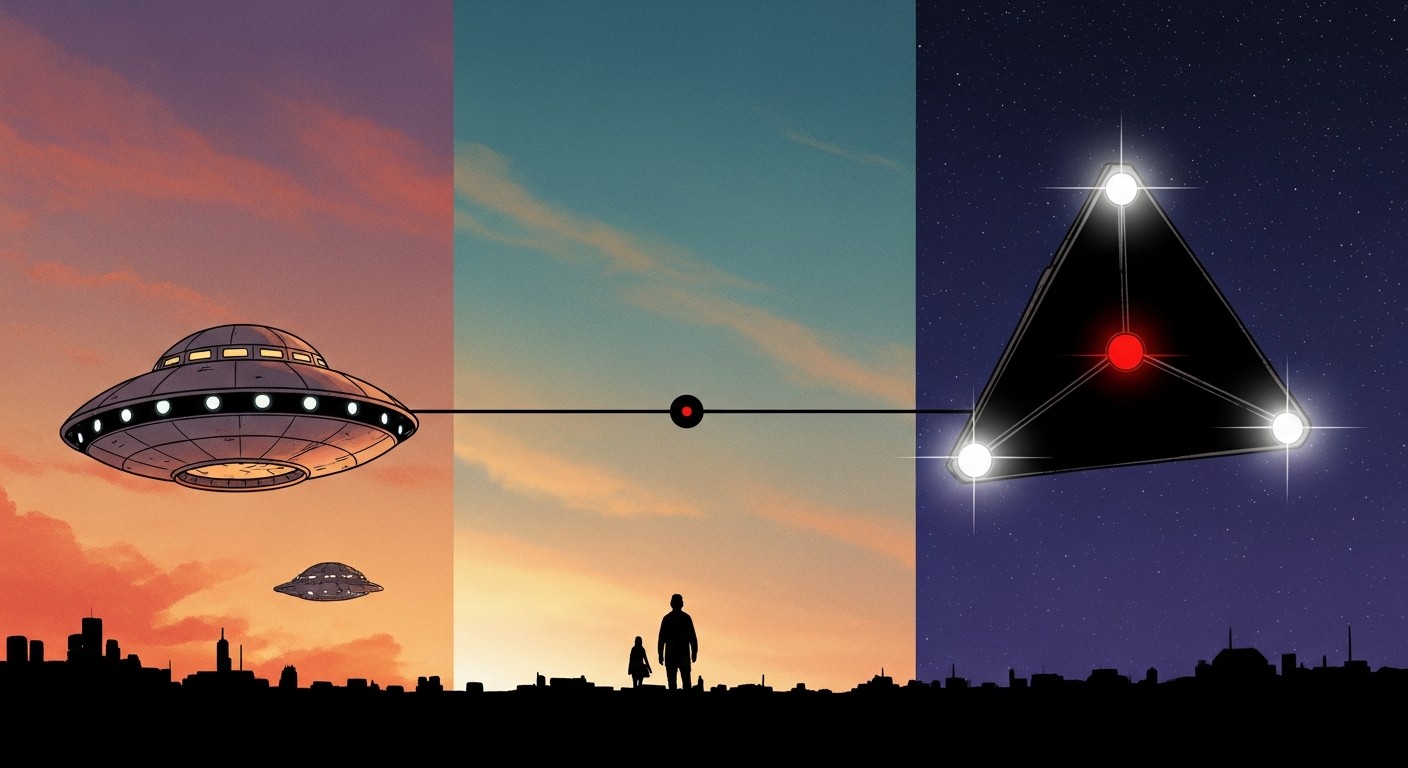
The Disc Era Ended in 1979: How UAP Shape Reports Rewrote Themselves
A decade-by-decade audit of 150,000+ shape-tagged reports shows the "flying saucer" was a 30-year cultural window, not a constant of the phenomenon.
The single most consistent finding in the Phenomainon shape-normalization pass is also the most disorienting one: the flying disc, the object that defined UAP iconography for two generations, accounts for 42.04% of 1950s reports and 3.10% of 2020s reports. Over the same span, the share of reports describing simply a "Light" climbs from 8.31% to 32.70%, and Triangles, statistically invisible before 1970, peak at 12.11% in the 1990s. The dataset does not say witnesses are seeing different things in the sky. It says witnesses are describing the sky differently, and that the description tracks closely with the decade.
The disc's 30-year window
Across the full 252,001-event master file, Disc remains the third most common normalized shape (19,523 events), behind Light (31,074) and the catch-all Other (26,165). That ranking masks a strongly time-bounded distribution. Disc reports cluster between the 1940s and the 1970s, where they account for 40.97%, 42.04%, 41.37% and 36.07% of all shape-tagged events in each respective decade. Outside that window, the disc is a minority descriptor.
The pre-1940 numbers are noisy because the underlying counts are small, but the pattern is still legible. Disc references exist as far back as the 1850s (55.56% of a very thin sample) and reappear in the 1910s (28.12%) and 1920s (44.62%), suggesting the visual template predates Kenneth Arnold's 1947 sighting by several decades. What changes after 1947 is volume, not vocabulary: the disc was already in the witness lexicon, and the post-war reporting boom amplified it into the dominant category.
The collapse is sharp. Disc share drops from 36.07% in the 1970s to 15.39% in the 1980s, halves again to 10.58% in the 1990s, and continues falling: 6.71% (2000s), 3.67% (2010s), 3.10% (2020s). No other major shape category shows a decline of comparable steepness over the same period.
Triangles arrive late, then plateau
The triangle is, statistically, a modern shape. Across the entire 1900-1969 span, triangle reports never exceed 1.16% of any decade's shape distribution, and several decades record zero. The category becomes meaningful in the 1970s (3.81%), doubles in the 1980s (7.80%), and peaks in the 1990s at 12.11% before settling into a 6 to 10% band through the 2020s.
This is not a slow drift. Between the 1960s (1.16%) and the 1990s (12.11%), the triangle's share of reports increased roughly tenfold. The timing aligns with the period of the well-documented Belgian wave and a broader proliferation of triangular-craft accounts in North America and Europe, but the dataset itself only documents the descriptive shift, not its cause. Whether the rise reflects a new class of object, new aircraft programs, new cultural priors, or some combination, the shape-tag data alone cannot say.
What the data can say is that the triangle has not collapsed the way the disc did. The 2020s share (6.13%) is lower than the 1990s peak but remains roughly five times the pre-1970 baseline.
"Light" eats everything
The most consequential shift is not disc-to-triangle. It is the steady rise of the least specific category in the taxonomy. Light reports climb almost monotonically from 5.41% in the 1940s to 32.70% in the 2020s. By the 2000s, Light is already the modal shape, and it has held that position for three consecutive decades (26.27%, 21.84%, 32.70%).
A 32.70% share for an unstructured descriptor is worth pausing on. It means roughly one in three modern reports describes a luminous point or glow with no resolved geometry. The dataset cannot distinguish, at the shape-tag level, between a witness who saw a structured craft at a distance too great to resolve, a witness who saw a genuinely shapeless light source, and a witness who saw a conventional object (satellite, Starlink train, drone, aircraft strobe) and reported it honestly as a light.
The rise of "Light" therefore does two things at once. It records a real change in what is being reported, and it degrades the diagnostic value of shape as a variable. Earlier decades forced witnesses, through the cultural frame available to them, to commit to a geometric description. Later decades increasingly do not.
Spheres as the stable baseline
Against this churn, Sphere reports are notably steady. The category sits between 7% and 14% in almost every decade from the 1900s onward: 9.38% (1910s), 13.85% (1920s), 13.30% (1940s), 10.69% (1950s), 9.98% (1970s), 11.07% (1980s), 10.38% (1990s), 8.59% (2000s), 7.39% (2010s), 5.30% (2020s). The recent decline is real but modest compared to the disc's collapse.
The persistence of the sphere across more than a century of reporting, through radically different media environments and cultural reference points, is the closest thing in the shape table to a control variable. It suggests that at least one descriptive category is relatively insulated from the cultural cycles that drove the disc up and then down, and that are now driving Light upward.
The top-shape-per-decade table
The single-row summary in the brief, top shape by decade, compresses the story cleanly. Disc holds the top slot for seven consecutive decades from the 1910s through the 1970s. The 1980s and 1990s default to Other, reflecting fragmentation of the descriptive vocabulary as no single category yet dominates. From the 2000s forward, Light is the modal shape in every decade. The flying saucer era, by this measure, runs from roughly 1910 to 1979, with its statistical core in the 1940s through 1960s.
What this doesn't tell us
The shape-tag distribution describes how witnesses and report-takers categorized what was seen. It does not describe what was in the sky. A decline in disc reports is consistent with at least three non-exclusive explanations: a real change in the population of observed objects, a change in the cultural templates witnesses use to describe ambiguous stimuli, and a change in how intake forms and investigators normalize free-text descriptions into canonical categories. The dataset's 18-shape taxonomy is itself an analytic choice that shapes the answer. What the numbers establish, and establish clearly, is that "flying saucer" was the dominant descriptor for a specific 30-year window, that it is not the dominant descriptor now, and that any theory of the phenomenon which treats the disc as a constant feature of UAP reporting is contradicted by its own source data.
Methodology: how the corpus was built. Sources: the 8 catalogs feeding the master.