The 100 Most-Credible Cases: What "Good Data" Actually Looks Like in UAP Research
When credibility is scored by sources, observer quality, and physical evidence, the top of the file is dominated by quiet trace cases, not the famous ones.
Of the 252,001 events in the master dataset, the 100 highest-credibility cases share one structural feature: every single one carries three or more independent sources. They are not, for the most part, the cases that show up in documentaries. They cluster in the 1950s and 1960s, they lean on physical traces and electromagnetic effects more than on dramatic visuals, and they are mostly unfamous. This is what the upper tail of evidence quality looks like once you stop ranking by notoriety and start ranking by what investigators actually documented.
How credibility was scored
The credibility index combines three signals mined from incident text: an evidence axis (photo, radar, trace, vehicle effect), multi-source corroboration (three or more independent references in the case file), and observer-quality flags (pilot, military, multi-witness, photo/video). Among the top 100, all 100 cleared the three-source threshold. Pilot flags appear on 13 cases, military on 6, multi-witness on 8, and photo on 9. The flags overlap, but the modest absolute numbers matter: even at the top of the credibility distribution, named observer-quality markers are the exception. What pushes most cases into the top 100 is not a pilot witness or a photograph but the combination of source density and physical-trace evidence.
That is a meaningful editorial choice. A radar-confirmed pilot encounter with a single news source can rank lower than a quiet rural ground-trace case that ten serious investigators wrote up over the following decade. The index rewards how the case was documented, not how loud it was.
When the best-documented cases happened
The decade distribution is lopsided. The 1950s contribute 37 of the top 100 and the 1960s contribute 35, together accounting for 72% of the file. The 1940s add 7, the 2000s add 9, the 1970s and 1990s contribute 4 each, and three earlier decades (1890s, 1910s, 1930s) supply 4 between them. The 1980s and 2010s contribute zero.
That is not a claim about when the phenomenon was most active. It is a claim about when the phenomenon was most carefully investigated and re-investigated. The mid-century cluster reflects the post-war investigative apparatus: civilian groups like NICAP and APRO, the Air Force's Blue Book program, French and Belgian researchers cataloguing the autumn 1954 wave, and decades of follow-up that layered source on source. PCF-020254 (1954-09-26, Chabeuil, France) carries 14 source references because the 1954 French wave was reworked by every serious European researcher for the next 40 years. The same compounding effect is what puts PCF-018831 (1954-06-21, Ridgeway, Ontario) at the top with 13 sources.
The near-absence of the 1980s, 2010s, and 2020s in the top 100 is a methodological warning. Modern cases have not yet had time to accumulate the kind of multi-decade reinvestigation that drives the credibility score upward. Anyone reading this file should assume the index is biased toward old, heavily-litigated incidents.
What the top cases actually contain
The single most striking pattern in the top 10 is how often the documented evidence is a vehicle or electrical effect, a ground trace, or a near-encounter at low altitude, rather than a long-distance light in the sky.
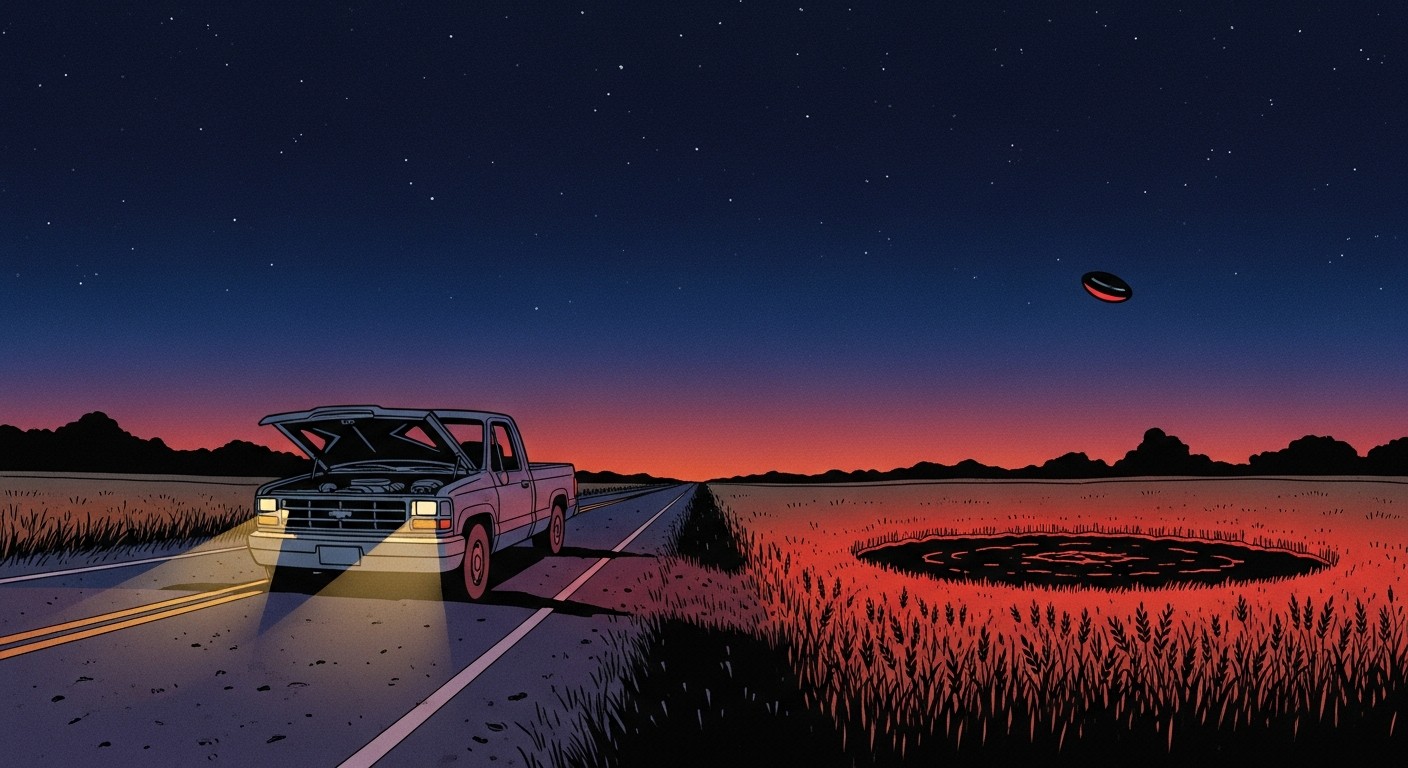
PCF-018831 (1954-06-21, Ridgeway, Ontario), the top-ranked case, is an ignition-interference event: a domed disc crosses a highway, the car's engine stalls. PCF-028160 (1957-08-22, Cecil NAS, Florida) is a pursuit case that ends the same way, with a stalled engine and a hovering object. PCF-029148 (1957-11-06, Danville, Illinois) involves two state police officers and a failed two-way radio. PCF-039991 (1965-01-12, Custer, Washington) documents a 10 to 12 foot ground circle alongside the visual observation. PCF-020254 (1954-09-26, Chabeuil, France) is also a trace case, classified under Catena 5 with physical marks at the site.
Five of the top 10 involve a documented physical or electromagnetic effect. That is the pattern. Trace and EM cases dominate the high-credibility tail because they generate something investigators can examine after the witness goes home: scorched soil, a circle of flattened vegetation, a vehicle that has to be restarted, a radio that has to be re-tuned.
The aerial cases in the top 10 share a different feature: trained observers. PCF-047478 (1967-01-13, Winslow, Arizona) involves a Lear jet crew and a National Airlines DC-8 captain, and carries both pilot and military flags. PCF-044897 (1966-05-21, Willow Grove NAS, Pennsylvania) is a daylight pilot encounter with a reported maneuver beneath the aircraft's wing. PCF-054106 (1967-10-25, Roosevelt, Utah) is a pilot observation followed by audible jet response. These are the cases where the witness's professional baseline does the same work that a ground trace does in the others.
Two cases sit slightly apart. PCF-048986 (1967-03-08, Leominster, Massachusetts) is a low-altitude visual with two witnesses and 13 source references, a case carried by depth of investigation rather than physical evidence. PCF-032121 (1959-06-26, Boianai, Papua New Guinea) is the lone high-strangeness case in the top 10, with 38 witnesses and the multi-witness flag, and is the only entry that most general readers would recognize by description.
What is missing from the top 100
The flag counts make the absences visible. Only 9 of the 100 highest-credibility cases carry a photo flag. Only 6 carry a military flag. The famous dramatic incidents that anchor popular UAP discourse, the gun-camera cases, the Nimitz-era videos, the high-altitude radar intercepts, are largely not here. Some are too recent to have accumulated source density. Some are documented in ways the text-mining pipeline does not capture as cleanly as a 1960s NICAP write-up. And some, frankly, do not survive the three-source corroboration test as well as their public profile suggests.
This is not a claim that the famous cases are weak. It is a claim that the cases that score highest on a transparent, documentation-weighted index look different from the cases that score highest on cultural memory.
What this tells us
The top 100 is a portrait of investigative tradecraft, not of the phenomenon itself. It says that when researchers built durable case files, they did so by anchoring on physical effects (ground traces, vehicle interference, radio failure) and on observers whose training constrained the interpretation. It says that mid-century civilian and military investigators built the records that still dominate the high-credibility tail 60 years later, and that nothing comparable has been built for the 1980s, 2010s, or 2020s, at least not yet. The credibility index is biased toward old, well-litigated cases. That bias is also the lesson: good UAP data is mostly the result of patient, repeated, multi-source documentation, and it usually does not look like the cases on television.
Methodology: how the corpus was built. Sources: the 8 catalogs feeding the master.